GLP‑1s: What’s available, what’s coming, and why they’re not a magic bullet
By Asha Valor
Updated October 31, 2026
GLP-1 medications have become familiar names, but their differences still matter. GLP-1 receptor agonists mimic a hormone involved in appetite, digestion, and blood sugar regulation. Several are approved for weight management, while newer treatments target additional hormone receptors.
What Is Available Now?
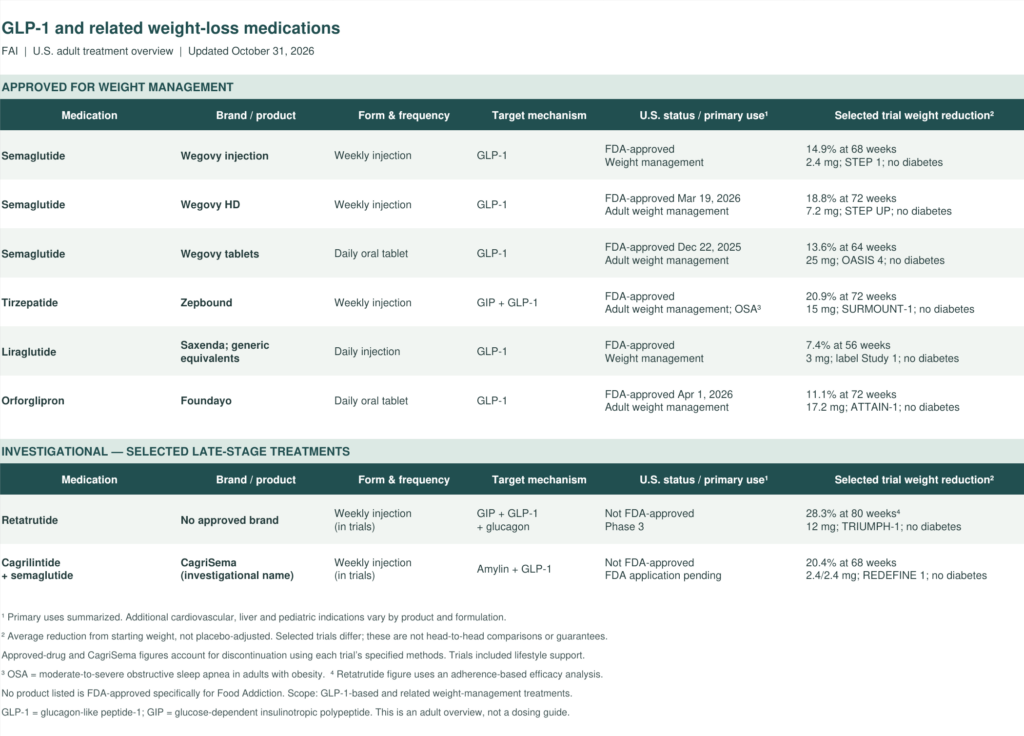
Semaglutide options include weekly Wegovy injections, the higher-dose Wegovy HD, and daily Wegovy tablets. Oral Wegovy, approved in December 2025, provides a pill option, although it must be taken on an empty stomach with specific water and timing instructions.
FDA approved Wegovy HD’s 7.2 mg injection on March 19, 2026. In STEP UP, participants without diabetes lost an average of 18.8% of their starting weight at 72 weeks in an analysis accounting for treatment discontinuation. That is greater than the standard dose’s result in the same trial, not three times the weight loss.
Tirzepatide activates both GLP-1 and GIP receptors. It is sold as Zepbound for weight management and also treats moderate-to-severe obstructive sleep apnea in adults with obesity.
Liraglutide, sold as Saxenda and available in generic equivalents, is an older daily injection for weight management. Its average weight reduction is smaller than that reported for several newer options, although individual responses and tolerability vary.
Foundayo, the daily oral GLP-1 orforglipron, received FDA approval for adult weight management on April 1, 2026. Its label reports average weight reduction of 11.1% at 72 weeks at the highest dose in participants without diabetes. It can be taken with or without food.
What Remains Uncertain?
Retatrutide, targeting GLP-1, GIP, and glucagon receptors, and CagriSema, combining semaglutide with cagrilintide, remain investigational. Both have Phase 3 results; neither is FDA-approved as of this update.
For FAI readers, weight reduction and Food Addiction outcomes are different measures. Research into cravings and eating behavior continues, but these medications are not FDA-approved specifically for Food Addiction. Weight loss alone does not establish recovery.
Nausea, vomiting, diarrhea, and constipation can affect continued use. Serious risks and contraindications vary by product. Cost and coverage also matter. Weight regain after stopping treatment is common, reflecting the potential need for ongoing care rather than a failure of willpower.
The accompanying chart distinguishes approved uses and selected trial results. Different doses, populations, and study methods mean its percentages should not be read as a direct ranking.
Source Materials
- Wegovy prescribing information and clinical trials
- FDA: Wegovy HD approval
- Zepbound prescribing information
- Saxenda prescribing information
- FDA: Foundayo prescribing information
- Retatrutide Phase 3 update
- CagriSema regulatory status, October 20, 2026
- 2026 systematic review: GLP-1-based medications and eating behavior
- STEP 1 extension: Weight regain after semaglutide withdrawal
- FDA: Generic Saxenda approval (FY2025 report)