By Susan Branscome
Board member
Food Addiction is a complex condition influenced by behavioral patterns and physiological responses to certain foods. To assess and diagnose Food Addiction, various screening tools — the Yale Food Addiction Scale, FASI, SUGAR, CRAVED, and several self-administered tools — have been developed. These tools help individuals determine whether they may have a Food
Addiction and serve as valuable resources for medical professionals in recognizing Food Addiction as a substance use disorder, comparable to alcohol and drug addiction. There are multiple screening methods used to evaluate Food Addiction, carbohydrate addiction, and sugar addiction. Each tool varies in its focus, theoretical foundation, and applicability in clinical and research settings. Below is an overview of the most widely used screening tools.
The Yale Food Addiction Scale (YFAS) is a 25-item questionnaire developed in 2009 by Dr. Ashley Gearhardt, in collaboration with William R. Corbin and Kelly D. Brownell, as part of her graduate research at Yale University. The YFAS is based on the diagnostic criteria for substance use disorders outlined in the Diagnostic and Statistical Manual of Mental Disorders (DSM) by the American Psychiatric Association.
Research using the YFAS has demonstrated that Food Addiction activates similar neural pathways as other substance dependence, such as those seen in individuals addicted to alcohol and drugs. Although “Food Addiction” is not yet an officially recognized diagnosis, the YFAS helps identify individuals exhibiting symptoms of physical dependency on certain foods.
The YFAS specifically examines addiction-like eating behaviors, including loss of control despite
negative consequences, withdrawal symptoms, tolerance, and cravings. It categorizes Food Addiction into three severity levels: mild, moderate, and severe.
The questionnaire assesses responses to the consumption of highly palatable foods, such as:
The Food Addiction Symptom Inventory is a semi-structured clinical interview developed to assess ultra-processed food (UPF) addiction, defined as addictive-like patterns of consumption specific to ultra-processed foods such as packaged snacks, sweets, and sugar-sweetened beverages. The FASI was adapted from the Structured Clinical Interview for DSM-5 (SCID-5), the gold-standard diagnostic interview for substance use disorders. It specifically models the alcohol use disorder module to parallel a widely accessible substance with similar population prevalence.
The interview maps directly onto DSM-5 substance use disorder criteria, including loss of control, craving, tolerance, withdrawal, continued use despite harm, and functional impairment. Symptoms are assessed over 12 months and require both symptom endorsement and clinically significant
distress or impairment. The FASI is designed to be administered by a clinician and includes guidance to distinguish addictive-like UPF intake from normative overeating, dietary restraint, and eating-disorder-driven pathology, while allowing for clinically appropriate comorbidity.
Psychometric evaluation shows the FASI is valid and reliable, with appropriate concordance with the Yale Food Addiction Scale 2.0 and strong agreement among raters. FASI is the first clinician-guided interview for UPF addiction, and provides a rigorous and standardized approach in both research and clinical settings.
SUGAR® (Sugar Use General Assessment Recording) is a diagnostic tool designed to assess sugar, carbohydrate, and processed Food Addiction. Developed by Bitten Jonsson in 2013, it is the first structured interview-based instrument dedicated to distinguishing between harmful use and true addiction, using criteria from ICD-10, ICD-11, and DSM-5.
Unlike general self-assessments, SUGAR® provides a comprehensive evaluation, differentiating stress/emotional eating from chemical addiction, which requires abstinence-based treatment. It also screens for Addiction Interaction Disorder (AID), recognizing addiction as a complex disease that can manifest in multiple forms.
The certification training equips healthcare professionals
with the skills to administer SUGAR®, improving diagnostic accuracy and treatment outcomes. The tool has been instrumental in reducing stigma, increasing motivation, and guiding appropriate treatment plans. SUGAR® certification complements Holistic Medicine for Addiction® (HMA®) training, further enhancing professionals’ ability to combat the rising epidemic of sugar and carb addiction.
With growing global demand, more certified practitioners are needed to address the widespread impact of ultra-processed food consumption. SUGAR® is continually updated to align with the latest addiction science, making it a transformative tool in the field of Food Addiction recovery.
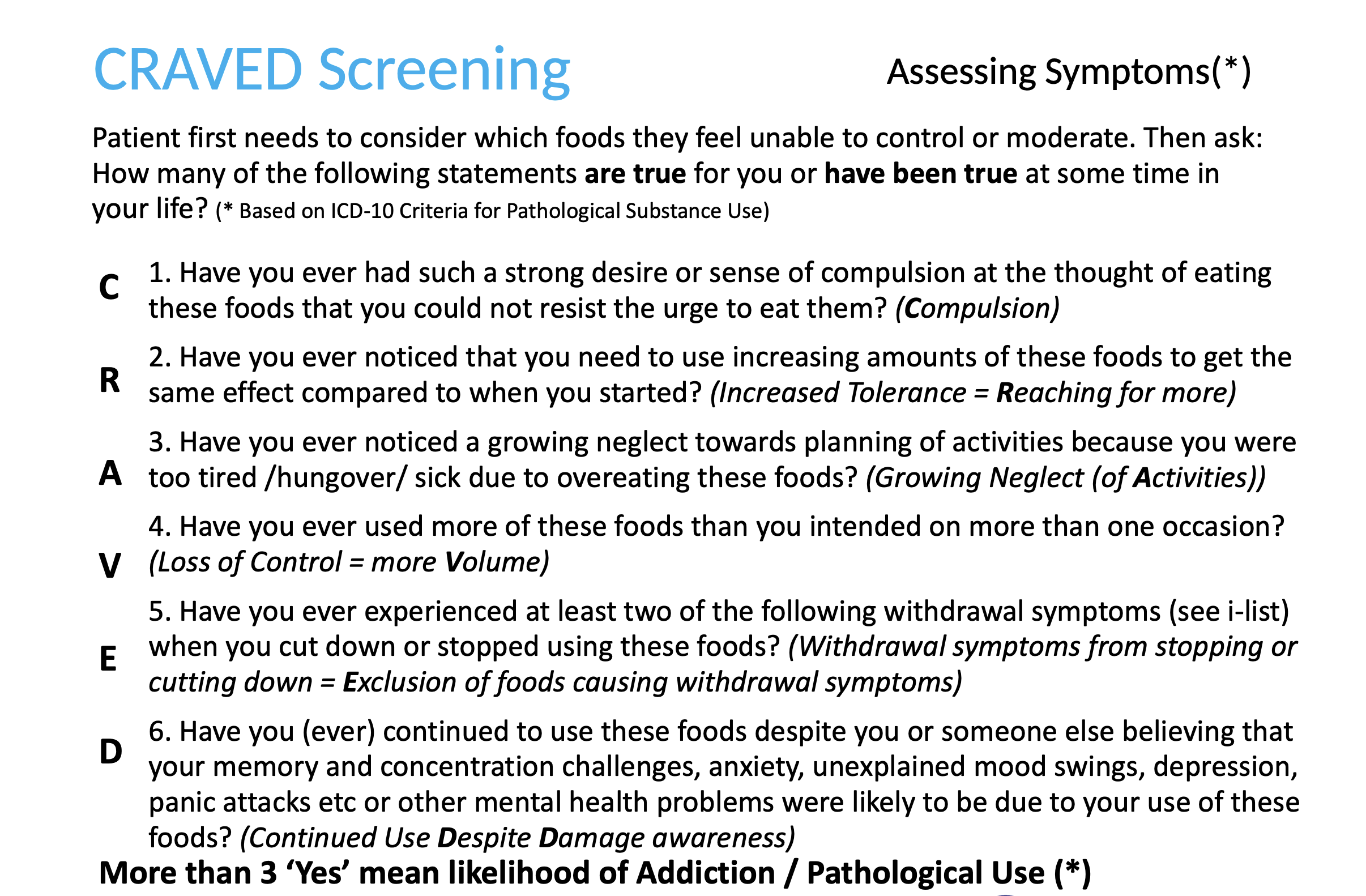
CRAVED is a six-question, yes-or-no screening tool that accounts for behavioral indicators of Food Addiction. It is a behavior-based screening tool designed to assess addiction-related symptoms associated with food consumption. It can be self-administered or used as a diagnostic tool by healthcare professionals in clinical settings.
Developed by Heidi Giaever and Jen Unwin of the Collaborative Health Community (CHC), the CRAVED assessment raises awareness of the growing prevalence of Food Addiction and its impact on physical and mental health. Uncontrolled food consumption can lead to weight-related health issues, emotional distress, and psychological conditions such as self-loathing and despair.
Various entities offer questionnaires that can help begin an exploration of Food Addiction and you, a loved one, or a patient/client.