
Parental health, pediatric obesity, the connection to mental health, and more
By Cynthia Myers-Morrison, EdD. FAP
Board secretary
Abstract
Childhood and adolescent obesity have become a major global health concern with serious short- and long-term consequences. This supplement reviews recent research in three connected areas: trends in pediatric obesity, the growing prevalence of fatty liver disease in young people, and the two-way relationship between excess weight and mental health.
It also examines how health risks may pass from one generation to the next. Maternal obesity, gestational diabetes, and paternal metabolic health are increasingly recognized as factors that may raise a child’s risk for obesity, fatty liver disease, and neurodevelopmental conditions such as autism. The review also considers biological pathways that may help explain these links, including inflammation, changes in how nutrients are transferred through the placenta, hormone imbalance, and changes in gene regulation.
Finally, the supplement discusses emerging treatment options, especially medications such as GLP-1 receptor agonists, which may be useful as additional therapy for adolescents with fatty liver disease. Throughout, the need for prevention before and during pregnancy is emphasized.
Keywords: childhood obesity, fatty liver disease, mental health, gene regulation, intergenerational effects, GLP-1 receptor agonists, autism, developmental origins of health and disease
Section 1.1: Global Trends in Childhood and Adolescent Obesity (2010–2025)
Rising Prevalence
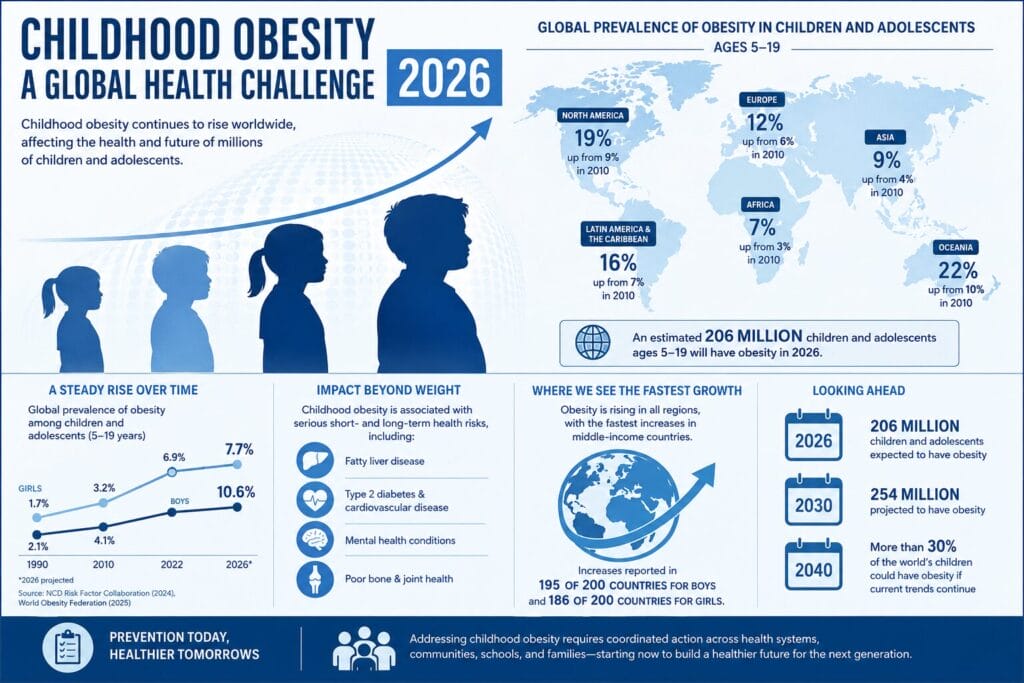
Childhood and adolescent obesity have increased sharply around the world over the past few decades. A pooled analysis by the NCD Risk Factor Collaboration (2024) found that from 1990 to 2022, obesity prevalence rose from about 1.7% to 6.9% in girls and from about 2.1% to 9.3% in boys. By 2022, an estimated 65 million girls and 94 million boys ages 5 to 19 were living with obesity. A 2024 Lancet update confirmed these trends, noting that obesity rates in youth have tripled since 1990. Recent meta-analyses suggest that about 8–9% of children and adolescents worldwide meet criteria for obesity, with rates ranging from 0.4% in Vanuatu to 28% in Puerto Rico. When overweight and obesity are combined, they now affect about one in five young people globally.
Regional Shifts
Childhood obesity is increasing in every region, with especially rapid growth in middle-income countries. Island nations in Polynesia, Micronesia, and parts of the Caribbean now report obesity rates above 30% among youth. NCD-RisC reports that obesity is increasing in 186 of 200 countries for girls and 195 countries for boys. Boys generally have slightly higher obesity rates than girls, and within countries, urban and higher-income settings often show greater risk, although this gap is narrowing in many developing nations.
New Projections
The World Obesity Federation projects that about 206 million youth ages 5 to 19 will have obesity by 2025 and 254 million by 2030. A 2022 meta-analysis estimated that global pediatric obesity prevalence increased 1.5-fold from 2000–2011 to 2012–2023. Some forecasts suggest that if current trends continue, more than 30% of the world’s children could have obesity by 2040. Together, these data show that childhood obesity has become a major global public health crisis.
Section 2.2: Paternal Obesity and Advanced Paternal Age—Links to Autism Risk
Paternal Obesity
New evidence suggests that a father’s weight at the time of conception can influence his child’s neurodevelopment. A large Norwegian cohort study found that paternal obesity was linked to a higher likelihood of autism in children, even after accounting for maternal factors. In that study, autistic disorder was diagnosed in 0.27% of children of obese fathers compared with 0.14% of children of fathers with a normal body weight. Paternal obesity was also linked to about twice the likelihood of Asperger syndrome in offspring. By contrast, maternal obesity before pregnancy showed only a weak link with autism in the same cohort. These findings suggest that paternal obesity is an independent risk factor for autism, possibly through genetic or epigenetic mechanisms, such as obesity-related changes in sperm or inflammation affecting reproductive cells.
Advanced Paternal Age
Large population studies consistently show that older paternal age is associated with a higher likelihood of autism in a dose-response pattern. One of the first strong studies, conducted in Israel in 2006, found that men in their 40s had nearly six times the chance of fathering a child with autism compared with men under 30. Fathers in their 30s had about 1.6 times the risk relative to those under 30. More recent meta-analyses confirm that fathers aged 50 years or older are about 2.2 times more likely to have an autistic child than fathers under 30. The most common explanation is that advancing age increases the number of new genetic mutations in sperm, as well as other genetic or epigenetic changes. Regardless of the exact mechanism, advanced paternal age is now recognized as one of the most consistent risk factors for autism in epidemiologic research.
Section 2.3: Intergenerational and Transgenerational Effects (Developmental Programming)
Barker’s Hypothesis—Early Foundations
The idea that early-life factors can shape long-term health was first developed by David J. Barker in the late 20th century. Barker’s landmark studies showed that low birthweight and poor maternal nutrition are linked to a higher risk of coronary heart disease, diabetes, and other chronic conditions in adulthood. This framework, known as the Developmental Origins of Health and Disease paradigm, suggests that the fetus adapts to conditions in the womb, and these adaptations can permanently affect how the body functions and how susceptible it is to disease later in life. Early environmental signals can trigger lasting changes—through altered organ development, metabolism, and gene regulation—that may appear as disease in later years.
Maternal Obesity and Epigenetic Programming
A growing body of research shows that maternal obesity can set offspring on a path toward obesity, fatty liver disease, and metabolic disease, and may even affect future generations. Hoffman and colleagues reviewed these mechanisms in detail, noting that maternal obesity creates an altered maternal–fetal environment marked by excess nutrients, insulin, leptin, and inflammatory signaling molecules. This environment can reprogram fetal metabolism and gene expression. As a result, children of mothers with obesity have higher risks of obesity, type 2 diabetes, fatty liver disease, and even neurodevelopmental disorders, which aligns with developmental programming theory.
One example of a transgenerational epigenetic effect involves paternal diet. Animal studies show that when male mice are fed a high-fat diet over multiple generations, their descendants develop increasing body fat and metabolic problems, even when intermediate generations are not directly exposed to the high-fat diet. This suggests that epigenetic marks in sperm can pass susceptibility to obesity across generations through mechanisms such as DNA methylation or noncoding RNA. These mechanisms include lasting changes in offspring DNA, histone modifications, microRNA expression, and stem cell populations that can be transmitted to future generations.
Section 3.1: Fatty Liver Disease Prevalence Trends in Youth (Updates Since ~2019)
Growing Burden
Nonalcoholic fatty liver disease — now often called metabolic dysfunction-associated steatotic liver disease — has become the most common chronic liver disease in children and adolescents. A 2022 meta-analysis that combined data from more than 20 countries found an overall fatty liver disease prevalence of 7.4% among youth. In children with obesity, fatty liver disease is especially common: the same analysis reported that about 52.5% of obese youths have it. Other estimates suggest that among children with obesity, approximately 30–40% have fatty liver disease.
Trends and Demographics
Trend analysis from 2000 to 2017 shows a significant global increase in fatty liver disease prevalence in young people, following the rise in obesity. In North America, fatty liver disease now affects about 8–10% of all children, with higher rates in Hispanic populations. In Europe, pediatric fatty liver disease prevalence has been reported at about 1–2%. There are also sex and ethnic differences: fatty liver disease is more common in boys than girls during adolescence, and Hispanic youth appear to be at higher risk.
Future Projections
The 2022 meta-analysis projected that if current trends continue, the global prevalence of fatty liver disease in youth could reach about 30% by 2040. Fatty liver disease in childhood often persists into adulthood, meaning that today’s cases in children may lead to a surge in young adults with advanced liver disease, cirrhosis, and liver cancer in the coming decades. Fatty liver disease is already becoming a leading reason for liver transplantation in adults.
Section 3.2: Maternal and Early-Life Risk Factors for Offspring Fatty Liver Disease (New Evidence Post-2021)
Maternal Obesity and Gestational Diabetes
A landmark Swedish nationwide cohort study found that children born to mothers with obesity had more than three times the likelihood of developing fatty liver disease by young adulthood compared with children of normal-weight mothers. Specifically, fatty liver disease was diagnosed in about 3.7% of offspring of mothers with obesity versus about 1.2% of offspring of mothers with normal body weight. This link was independent of maternal diabetes or preeclampsia, suggesting that maternal body fat itself contributes to fetal programming of fatty liver risk. A 2022 Chinese prospective study that followed children to age 8 found that maternal obesity significantly increased the likelihood of pediatric fatty liver disease and obesity, with children of obese mothers having about twice the rate of fatty liver disease compared with children of normal-weight mothers.
Maternal gestational diabetes is another important risk factor. Offspring of mothers with gestational diabetes had much higher rates of overweight and fatty liver disease by age 8 compared with offspring of mothers without gestational diabetes. After accounting for multiple factors, maternal gestational diabetes alone increased the likelihood of childhood overweight or obesity by about threefold. When maternal obesity and gestational diabetes occurred together, one analysis found that the child’s likelihood of fatty liver disease was about 8 times higher.
Other Early-Life Factors and Implications
A 2022 systematic review of 33 studies concluded that maternal prepregnancy overweight and obesity are modifiable risk factors for pediatric fatty liver disease and also identified gestational diabetes and possibly maternal dyslipidemia as contributing factors. These studies show that prevention of pediatric fatty liver disease must begin before and during pregnancy. Optimizing maternal health—achieving a healthy prepregnancy weight, appropriate gestational weight gain, and good blood sugar control — appears essential for breaking the cycle of risk across generations.
Section 3.4: Long-Term Consequences and Intervention Strategies
Consequences of Pediatric Obesity and Fatty Liver Disease
Children with obesity and fatty liver disease face serious long-term health risks. Fatty liver disease in youth can progress to more severe liver disease with fibrosis by adolescence, and these individuals are at higher risk of cirrhosis and liver cancer in adulthood. Longitudinal studies show that youth with fatty liver disease are more likely to develop type 2 diabetes, abnormal blood lipids, and cardiovascular disease as they age. Early intervention is therefore critical to change this course.
Weight Loss and Dietary Approaches
The main way to reduce liver fat in children remains weight loss through lifestyle changes. Sustained weight loss—defined as a 5% or greater decrease in body mass index percentile—is associated with improvements in liver tissue in pediatric fatty liver disease with inflammation. In real-world pediatric obesity clinics, intensive behavioral therapy for 6 to 12 months typically results in an average body mass index reduction of only about 2–3% from the 95th percentile, which is far below what is needed for full resolution of fatty liver disease in most cases. Diets very low in free sugars appear especially helpful. A Mediterranean-style diet — rich in fruits, vegetables, whole grains, and unsaturated fats — has been associated with lower liver fat and lower liver enzyme levels in children. Exercise, both aerobic and resistance training, improves liver fat content and liver enzyme levels even without weight loss.
Emerging Therapies
For severe cases, especially in adolescents with extreme obesity, medication is now an option. A few small trials have tested vitamin E and metformin in pediatric fatty liver disease. Vitamin E showed some benefit in liver tissue among children with inflammation and fatty liver disease who did not have diabetes, while metformin has not consistently improved liver histology. In summary, reducing liver fat and preventing obesity in youth requires a multi-part approach: early prevention, lifestyle changes, and for high-risk individuals, medical therapies—all supported by family and community environments.
Section 4.2: Biological and Psychosocial Pathways Linking Obesity With Mental Health Outcomes
Chronic Inflammation and Neurobiology
Obesity is marked by chronic low-grade inflammation, sometimes called metaflammation. Fat tissue releases pro-inflammatory signaling molecules, such as TNF-alpha and interleukin-6, that can cross the blood-brain barrier and affect brain function. This can contribute to chemical changes in the brain linked with depression and anxiety. Inflammation driven by obesity can alter serotonin and dopamine pathways and activate the body’s stress-response system, leading to depressive symptoms. Hormones produced by fat tissue, such as leptin and insulin, which are elevated in obesity, also play a role in brain signaling. Leptin resistance in the hypothalamus may affect mood regulation and reward processing.
Psychosocial Stress and Stigma
Psychological factors also play an important role in the link between obesity and mental health. Children and adolescents with obesity often face weight-related stigma, bullying, and discrimination, which can lower self-esteem and reduce social connection. One meta-analysis found that the likelihood of depression was higher in children with obesity, even after adjusting for baseline mental health. Youth with obesity are about 30–40% more likely to develop depression by young adulthood compared with their normal-weight peers. The relationship likely works in both directions: obesity can cause emotional distress, and emotional problems can lead to disordered eating and further weight gain, creating a vicious cycle.
Neurodevelopmental Outcomes
Maternal obesity during pregnancy is linked to activation of the maternal immune system, which can affect the developing fetal brain and may increase the risk of conditions such as attention-deficit/hyperactivity disorder or autism in the child. Inflammation in the womb may disrupt normal brain development by altering microglial cells and synaptic pruning in the fetal brain. A consistent theme in the literature is that inflammation and metabolic dysfunction from obesity may subtly affect brain development and function over time, influencing both neurodevelopmental and mental health outcomes.
Section 4.3: Maternal and Paternal Influences on Autism Risk
Maternal Pre-Pregnancy Obesity
Maternal obesity has emerged as a consistent, though modest, risk factor for autism. A comprehensive 2023 meta-analysis of 42 studies, covering about 3.7 million mother–child pairs, found that maternal pre-conception overweight was associated with about a 9% increase in the likelihood of autism in offspring, while maternal obesity was associated with a 42% increase in risk, compared with mothers with a healthy body weight. Children born to women who were obese before pregnancy had about 1.4 times the likelihood of autism. In addition, obesity during pregnancy itself was linked to about twice the likelihood of autism in the child. These findings are consistent with earlier epidemiologic studies, which found about a 1.3 to 2.0 times higher likelihood of autism in children of obese mothers.
The mechanisms behind this link are still being studied. Maternal obesity is known to cause higher levels of inflammatory signaling molecules, excess insulin, and oxidative stress during pregnancy, which can affect the developing fetal brain. Maternal immune activation has been implicated in autism. Excess nutrients and imbalanced metabolic hormones in an obese pregnancy may also alter fetal brain growth and synapse formation.
Maternal Metabolic Conditions and Paternal Influences
Maternal diabetes—both before pregnancy and gestational diabetes—has also been associated with a higher likelihood of autism. Mothers with both obesity and diabetes may have nearly additive risk. One study found autism prevalence about twice as high in children of women who had both obesity and gestational diabetes compared with women who had neither condition. On the paternal side, advanced age and obesity are consistently linked to a higher likelihood of autism. Paternal age over 40 carries a significantly elevated likelihood of autism—about six times higher compared with fathers under 30. Paternal obesity was associated with nearly a twofold increase in autism risk in the Norwegian MoBa cohort. These findings highlight the importance of parental health even before conception. Optimizing weight and metabolic health in prospective parents may help reduce the risk of neurodevelopmental disorders in their children.
Section 5.1: Mechanistic Pathways of Maternal Obesity—Inflammation, Signals, and Fetal Programming
Systemic and Placental Inflammation
Women with obesity enter pregnancy with higher levels of pro-inflammatory signaling molecules and often develop chronic inflammation in maternal tissues and the placenta. The placentas of obese mothers frequently show clear signs of inflammation and low oxygen levels. In effect, an obese pregnancy creates a pro-inflammatory environment that the fetus is exposed to during critical periods of organ development. This can reprogram fetal appetite regulators in the hypothalamus and alter insulin sensitivity. Such early immune activation is linked to insulin resistance and brain inflammation later in life.
Altered Nutrient and Hormonal Signals
Obese mothers typically have excess glucose, free fatty acids, insulin, and leptin in their bloodstream. These nutrients and hormones can cross the placenta or signal through it. As a result, the fetus of an obese mother is often in a state of overnutrition—experiencing high sugar and fat levels that trigger excess insulin production and increased fat storage. Leptin is especially elevated in obese pregnancies; cord blood leptin levels are significantly higher in infants born to mothers with obesity. Animal studies have shown that maternal obesity-induced excess leptin and insulin in the fetus lead to offspring that develop excessive eating and obesity after birth.
Placental Dysfunction and Epigenetic Programming
Studies show changes in placental nutrient transporters, including increased expression of glucose and amino acid transporters, which can lead to fetal overnutrition. Maternal obesity has also been linked to changes in DNA methylation, histone modifications, and microRNA expression in fetal tissues. Children born to obese mothers exhibit differences in methylation of genes involved in energy metabolism and inflammation, resulting in lasting changes in gene expression. For example, genes involved in insulin signaling or fat cell development may be epigenetically primed to function poorly.
In summary, maternal obesity sets off a chain of biological effects: an inflammatory environment in the womb, excessive and altered delivery of nutrients and hormones, placental dysfunction, and epigenetic reprogramming of the fetus. These pathways combine to increase the offspring’s lifelong risk of obesity, fatty liver disease, insulin resistance, and even mental health and neurodevelopmental disorders. The consensus is that maternal obesity has multiple biological impacts on the fetus, underscoring the urgency of addressing obesity in women of childbearing age to break the cycle of metabolic programming across generations.
Section 6.3: GLP-1 Receptor Agonists and Pediatric Fatty Liver Disease—A New Therapeutic Avenue
Rationale —Weight Loss and Metabolic Effects
GLP-1 receptor agonists—a class of medications that includes liraglutide and semaglutide—mimic the hormone GLP-1, which helps regulate blood sugar and appetite. These drugs promote significant weight loss by reducing appetite and improving insulin sensitivity. Because obesity and insulin resistance are key drivers of fatty liver disease, GLP-1 receptor agonists have the potential to benefit this condition. Studies in adults have shown that these medications reduce liver fat and improve liver tissue in fatty liver disease with inflammation. Semaglutide, a strong once-weekly GLP-1 receptor agonist, was recently tested in a phase II trial in adults with fatty liver disease-related cirrhosis. It led to the resolution of the inflammatory liver disease in a high proportion of patients and slowed the progression of fibrosis.
Pediatric Use — Emerging Data
Semaglutide, given once weekly at 2.4 milligrams, was studied in the STEP TEENS trial for adolescents with obesity and produced an average weight loss of about 16% over 68 weeks. Participants taking semaglutide also showed improvements in metabolic markers, including significant decreases in liver enzyme levels, which can reflect liver fat and inflammation, compared with placebo. A case series evaluating GLP-1 receptor agonist use in adolescents with type 2 diabetes and elevated liver enzyme levels found that treatment led to notable reductions over 6 to 12 months, suggesting improved liver health. These early results in youth are similar to adult outcomes and suggest that GLP-1 receptor agonists could treat both obesity and fatty liver disease simultaneously.
Safety, Considerations, and Conclusion
A 2024 commentary described GLP-1 analogs as a potential new medication for pediatric metabolic dysfunction-associated steatotic liver disease, highlighting their combined metabolic and anti-inflammatory effects. GLP-1 acts on pancreatic beta cells and also has benefits outside the pancreas, including improved insulin sensitivity in the liver, reduced liver fat production, and decreased visceral fat. GLP-1 receptor agonists in adolescents have shown a safety profile similar to that in adults, with mainly gastrointestinal side effects such as nausea, vomiting, and no severe low blood sugar. Long-term data in youth are still lacking. If these drugs prove effective, GLP-1 analogs may become part of standard care for severe adolescent fatty liver disease, marking the first effective medication for this growing epidemic in children.